


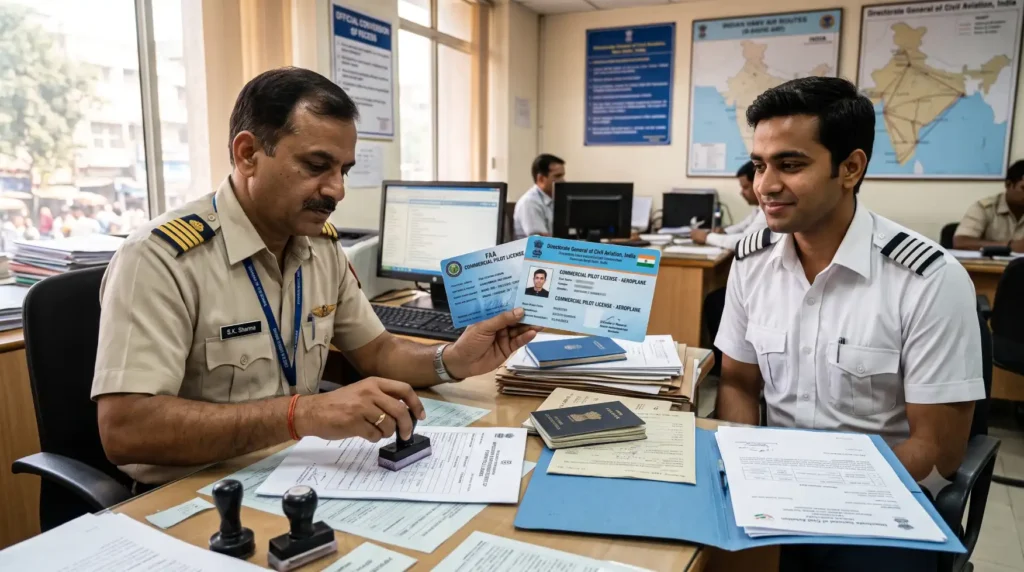
DGCA licence conversion is the regulatory process by which the Directorate General of Civil Aviation validates a pilot licence issued by another ICAO contracting state — the FAA (USA), EASA (Europe), SACAA (South Africa), GCAA (UAE), or any comparable authority — and reissues it as an Indian Commercial Pilot Licence (CPL) or Airline Transport Pilot Licence (ATPL). It is governed by CAR Section 7, Series ‘G’, Part I, and it is the mandatory gateway for anyone who trained abroad and wants to fly for an Indian airline or operate under an Indian Air Operator Certificate.
You need this conversion if you are an Indian national (or, in limited cases, a foreign national) holding a foreign CPL/ATPL who wants to log flight time, sit type-rating courses, or take up a flying job in India. A foreign licence alone does not authorise you to fly commercially in Indian airspace or for an Indian carrier.
Timelines vary a lot depending on how “conversion-ready” your file is. A candidate who cleared the DGCA papers before leaving India, kept recency current, and has a clean logbook can realistically be issued a licence in 8 to 14 weeks. Candidates who still need to clear exams, top up flying hours, or chase down authentication from a foreign school should budget 3 to 6 months. The single biggest driver of delay is not the flying — it’s paperwork that isn’t verified, translated, or authenticated the first time correctly.
Everything starts with an honest audit of what you already have versus what DGCA will ask for. At a minimum, you need:
This step matters because a large share of conversion delays stem from documents that are incomplete, unauthenticated, or issued in a format that DGCA’s eGCA portal doesn’t recognise. Start collecting certified copies from your flight school and civil aviation authority 1–2 months before you finish training abroad — logbooks and letters get harder to obtain once you’ve left the country and the school’s admin has moved on to the next cohort.
No foreign licence is accepted “as is.” DGCA requires you to clear specific written DGCA theory exams administered by the Central Examination Organisation (CEO), regardless of which foreign authority issued your original licence:
These results stay valid for up to five years from the date you pass them to the date you file your conversion application, so many candidates clear these papers on a trip back to India while still mid-training abroad — it removes one major variable from the timeline later. You’ll also need an Indian RTR(A) licence if you don’t already hold flight radiotelephony authorisation, and your ELP must be current or re-validated in India.
This is the step where FAA, EASA, SACAA and GCAA candidates diverge slightly in workload, because each home syllabus overlaps with the DGCA papers to a different degree — see the comparison table below.
DGCA credits the flight time you logged abroad — your hours don’t reset to zero. However, you may still need additional flying in India if:
You’ll also need to maintain recency: a minimum of 15 hours as pilot-in-command within the 6 months immediately preceding your application. This trips up more candidates than any other single requirement, because it’s assessed from the date your file is complete, not the date you started the process — a paperwork delay can silently burn through your recency window.
Once your documents are authenticated, your gap papers are cleared, and your hours/skill tests are complete, you file through the eGCA portal:
DGCA verifies the full file — medical, exam results, logbook, education verification — before issuing the Indian CPL or ATPL with the appropriate ratings endorsed. Most rejections or “returns for correction” at this stage come down to expired medicals, exam results that have lapsed, or missing English language proficiency or documentation, all of which are avoidable if Step 1 was done properly.
Home Licence | Recognising DGCA Requirement | Typical Gap Papers | Extra Flying Hours |
FAA (USA) | ICAO-compliant CPL/ATPL accepted under CAR 7-G-I | Air Regulation + Composite (Met & Nav); often more instrument-flying exposure needed since US training is VFR-heavy | Commonly need instrument or cross-country top-up if training leaned on visual flight rules |
EASA (Europe) | ICAO-compliant CPL/ATPL accepted; strongest theory overlap with DGCA papers | Air Regulation + Composite; EASA’s 14-subject ATPL theory usually covers DGCA content well | Typically minimal — EASA integrated courses already build in instrument and multi-crew hours |
SACAA (South Africa) | ICAO-compliant CPL/ATPL accepted | Air Regulation + Composite; check ELP and RTR documentation carefully | Usually modest; multi-engine hours sometimes need supplementing depending on the school |
GCAA (UAE) | ICAO-compliant CPL/ATPL accepted | Air Regulation + Composite; UAE academies often follow EASA-aligned syllabi | Varies by academy; verify cross-country legs match DGCA’s expected day/night distances |
Note: the exact gap-paper and hours picture depends on your individual training school’s syllabus and how your logbook is structured — this table reflects general patterns, not a guarantee for any individual applicant. A proper document audit (Step 1) is what actually tells you your personal gap.
Yes. The FAA is an ICAO contracting state, so an FAA CPL or ATPL is eligible for conversion under CAR Section 7, Series ‘G’, Part I, provided your licence, medical, and English language proficiency are current, and your logbook is properly authenticated. You will still need to pass DGCA’s Air Regulation and Composite theory papers, hold a valid Indian Class 1 medical, and complete any skill test required for the aircraft type you want endorsed on your Indian licence. See our DGCA CPL course details for how this fits into a full training pathway.
For a well-prepared applicant — exams cleared in advance, documents authenticated, recency maintained — 8 to 14 weeks is a realistic range from filing to issue. If you still need to clear theory papers, complete additional flying hours, or resolve documentation gaps (a common issue with foreign school verifications), the process can extend to 3–6 months. Filing early and keeping your 15-hour recency window active while documents are being processed is the most effective way to protect your timeline.
Not automatically — DGCA credits the flight experience you gained abroad toward your total hours, regardless of where you trained, as long as the aircraft type falls within the Aircraft Rules definition of an aeroplane. You will need additional flying only in specific cases: if your total hours fall short of DGCA’s CPL minimum, if a multi-engine or instrument rating wasn’t part of your original training, or if the aircraft type you want endorsed isn’t registered/accepted in India, which triggers a mandatory in-country skill test regardless of what you hold abroad.
DGCA licence conversion is a well-defined process, not a bureaucratic black box — but it rewards preparation. Candidates who audit their documents early, clear the DGCA theory papers before finishing abroad, and protect their flying recency consistently convert faster than those who wait until they land back in India to start asking questions. If you trained on an FAA, EASA, SACAA, or GCAA licence and are planning your route into Indian commercial aviation, mapping your personal document and hours gap now is the single highest-leverage thing you can do before you file for conversion.